A Reading Path Down a Rabbit Hole: Suchitra Mattai
Selected conversations, interviews and profiles with and about Guyanese, Indo-Caribbean mixed media artist Suchitra Mattai
Quotes & images
So much of my work is about creating a new mythology and new heroines and celebrating and monumentalizing women’s work and labor. …To produce her mesmerizing works, Mattai draws on a multitude of found and sourced objects that range from vintage saris, tapestries, and antique needlepoints to hair rollers, jewelry, and furniture.
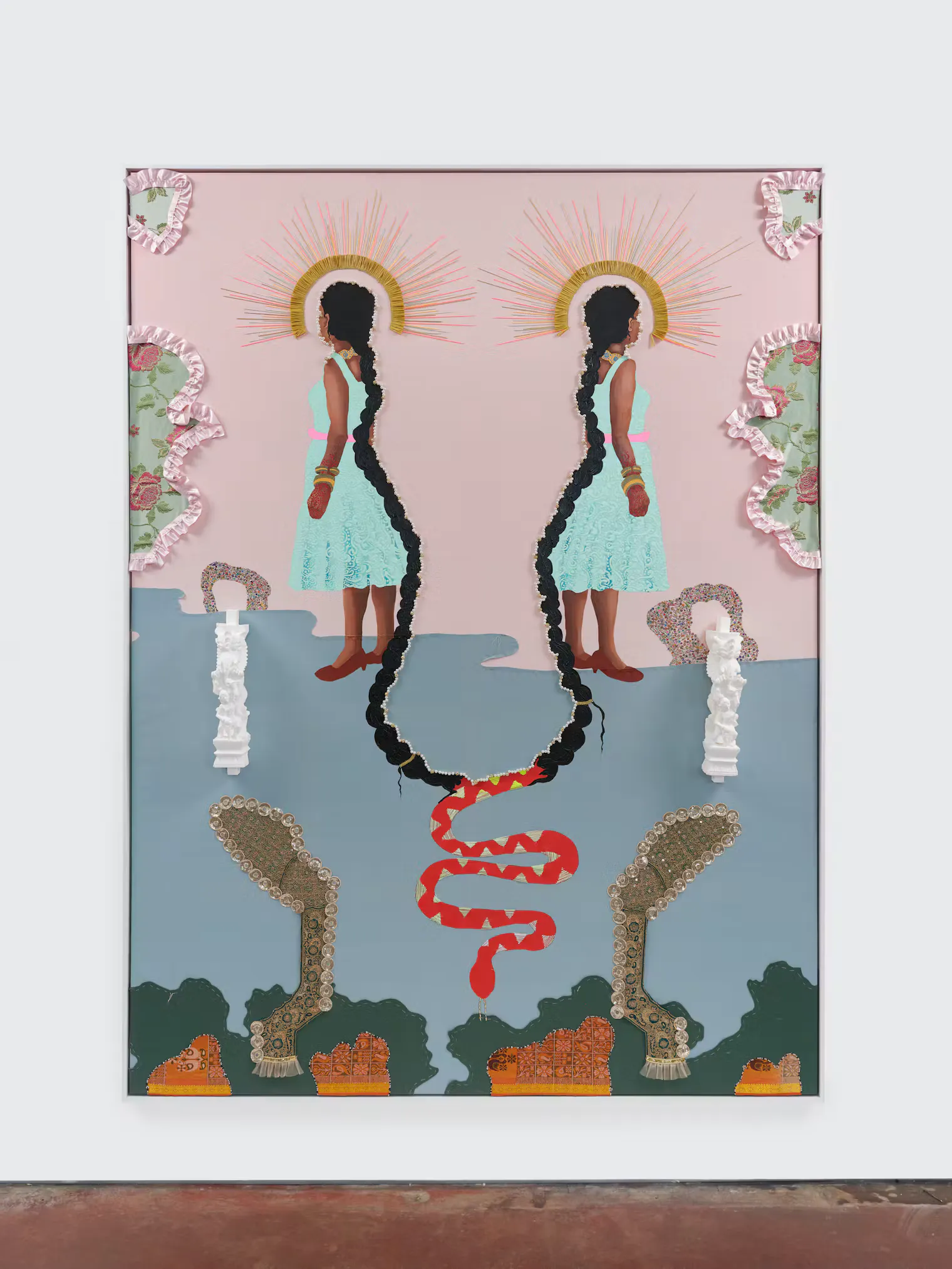
sweet surrender, 2021-24
Courtesy of the artist and Roberts Projects, Los Angeles; © Suchitra Mattai; Photo by Wes Magyar
Jan Garden Castro: This year, you had three concurrent solo exhibitions over the summer and early fall. “We are nomads, we are dreamers” at Socrates Sculpture Park featured a number of outdoor works, including six color-rich, sloping forms, described as “pods,” that evoked continents. Their mirrored tops, reflecting the sky and its cloud formations, gave a sense of movement to these rooted monoliths. What was the symbolism behind the shapes, materials, and colors?
Suchitra Mattai: I wanted these forms to feel like they were either being excavated from the ground or descending from the sky—dropped like artifacts from the future. I was also thinking of them as tectonic shapes. I partially grew up in Nova Scotia, where I was struck by the huge glacial deposits scattered across the land, in places like Peggy’s Cove. These objects, in a way, are migratory.
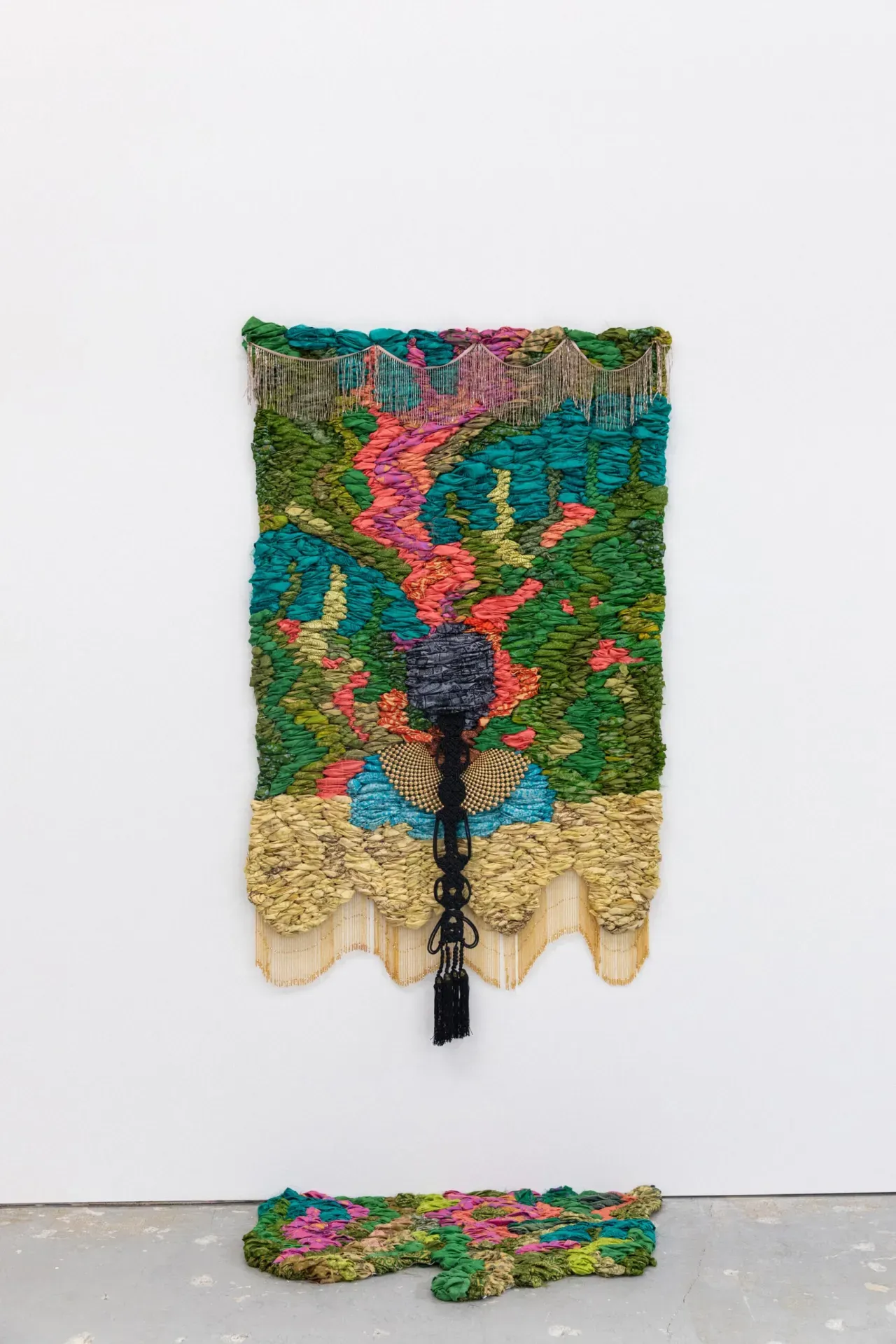
and the world swallowed her whole, 2023. Worn saris, fabric, and vintage servant pull, 87.5 x 41 x 24 in. Photo: Nicholas Lea Bruno
Journal of Indentureship and Its Legacies
MB: Have you always had this desire to move around? Or has it been more circumstantial?
SM: … I’ve heard other Guyanese people talk about this, as well as people who have migrated from other places. I think it’s almost like no where ever feels exactly like home. There’s that ‘myth of home’, but for me it’s less about searching and just about being inspired, both as an artist and as a person.
MB: When you think of ‘home,’ what does it smell like? What does it sound like? What does it taste like?
SM: It smells like Lalah’s curry powder, which is one of the brands you get in the Caribbean for curry. It sounds like late 1950s / 1960s Bollywood as that’s what I grew up on. And also Calypso and Soca music, which I grew up listening to. It tastes like curry!
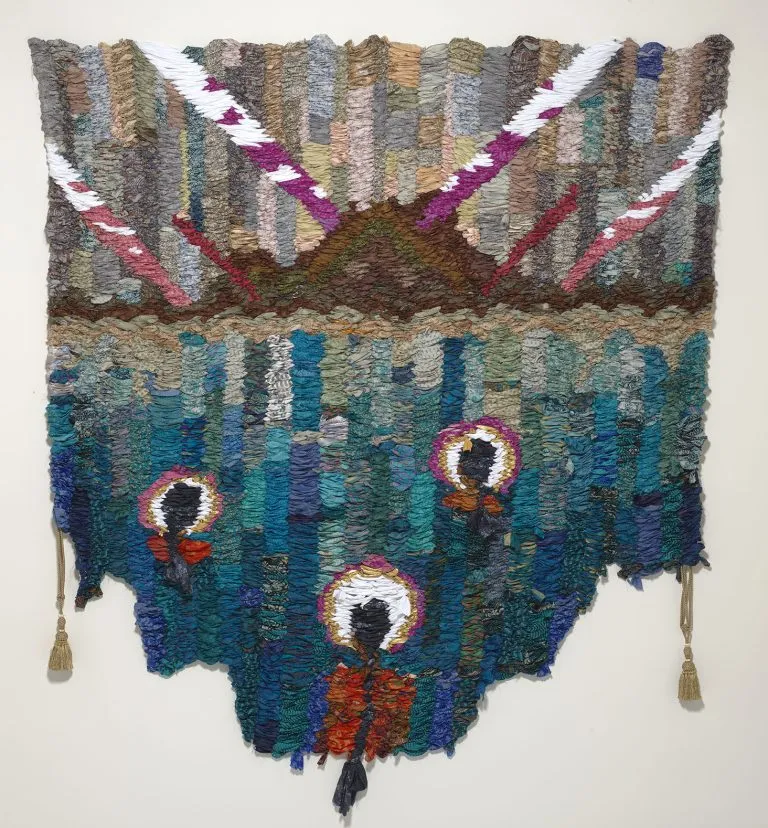
Suchitra Mattai, the light we know and the dark we keep (detail), 2022. Vintage saris, fabric and tassels; 122 × 115 inches (309.88 × 292.1 cm). Collection of the Nasher Museum of Art at Duke University. Museum purchase with additional funds provided by Jennifer McCracken New (A.B.’90, J.D.’94) and Jason G. New (J.D.’94), Stefanie (P’11, P’13, P’20) and Douglas Kahn (P’11, P’13, P’20) and The Duke Endowment, 2023.7.1. © Suchitra Mattai. Courtesy of the artist and Kavi Gupta, Chicago. Photo by Brian Quinby.
MB: Where do you source the saris from?
SM: I get vintage saris from all over: mostly from India, but from my family, too, and my mom’s friends or other people. When you open the boxes up, sometimes they smell like curry, sometimes they smell like perfume! You feel so connected to whoever wore them because they’re worn garments, they’re of the body, and they have history within them…
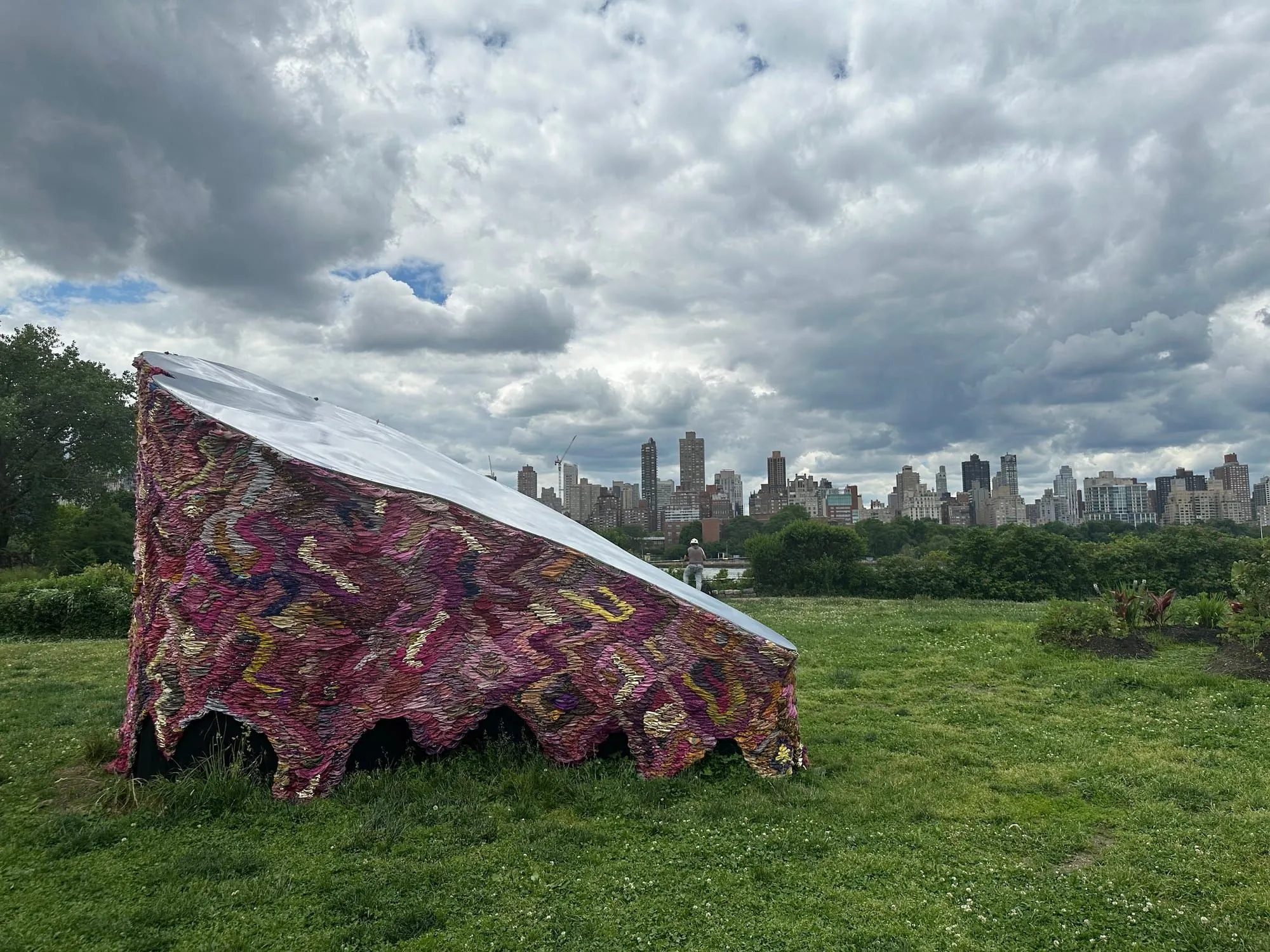
Suchitra Mattai’s We are nomads, we are dreamers at Socrates Sculpture Park in Queens during my visit in May (all photos Lakshmi Rivera Amin/Hyperallergic)
MB: Water imagery also comes up a lot in your work.
SM: Totally. Nova Scotia is on the Atlantic, Guyana is on the Atlantic, New Jersey is on the Atlantic, New York is on the Atlantic. It’s basically a migration up and then down the Atlantic. Even with the tapestries, I’ve tried to create that tumultuous yet peaceful space, full of depth, where it becomes a metaphor for where so many of the passages and experiences of my family.
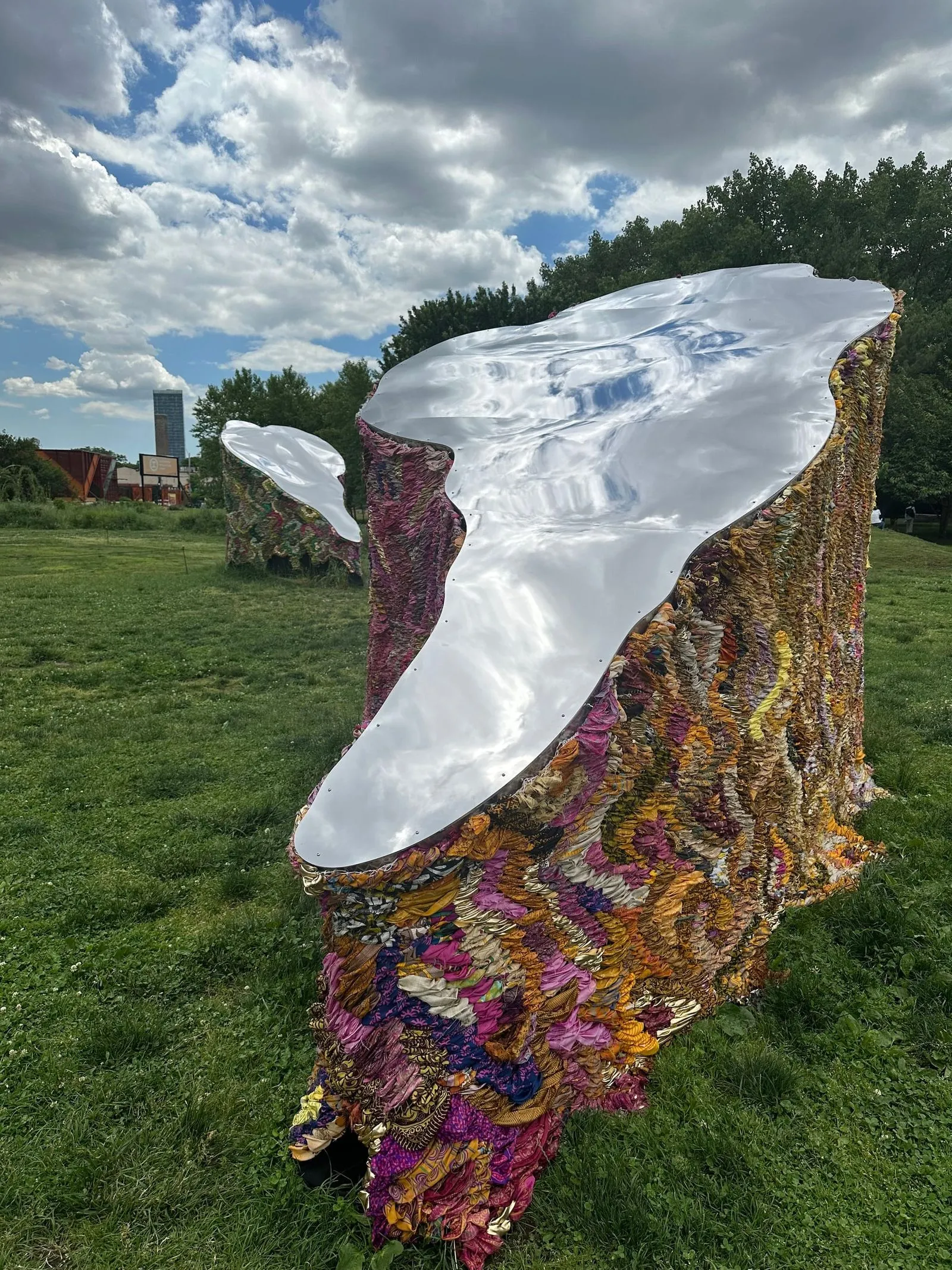
The organic shapes recall maps of South America and South Asia, with a reflection of the sky in place of internal borders.
Change, evolution, and cyclicality are quite literally built into the sculptures themselves, which Mattai said she wanted to both organically sprout from the ground and land as glacial artifacts flown in from the future. Fashioned from used saris that the artist sourced from India and New Jersey, the woven patterns affixed to a metal armature sloped downward toward the circle’s center, as if forming strange spokes in an unseen wheel.
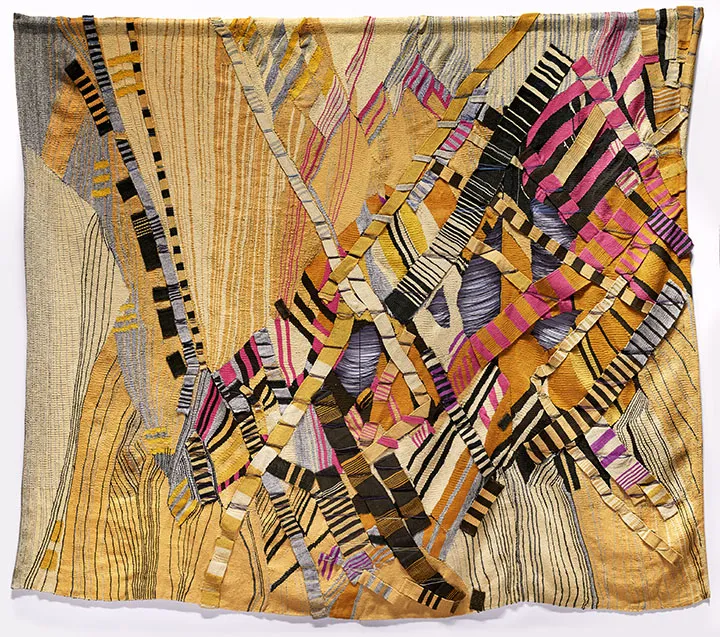
Silvia Heyden, Hurricane, 20th century. Silk and linen, 80 3/4 × 94 1/4 inches (205.1 × 239.4 cm). Collection of the Nasher Museum of Art at Duke University. Gift of Mary D.B.T. Semans and James H. Semans, M.D.; 1976.101.1. © Silvia Heyden Estate. Photo by Peter Paul Geoffrion.
Suchitra, how did you become an artist?
I guess I never had role models who were artists. I couldn’t possibly have conceived of how one could be an artist. I entered a P.h.D. program in Art History (focusing on South Asian art) at the University of Pennsylvania and it was a way for me to get back in touch with my roots. Finally, one day, I was in a class and thought “this is ridiculous, what am I doing?” I shouldn’t only be studying art, I should be making it….
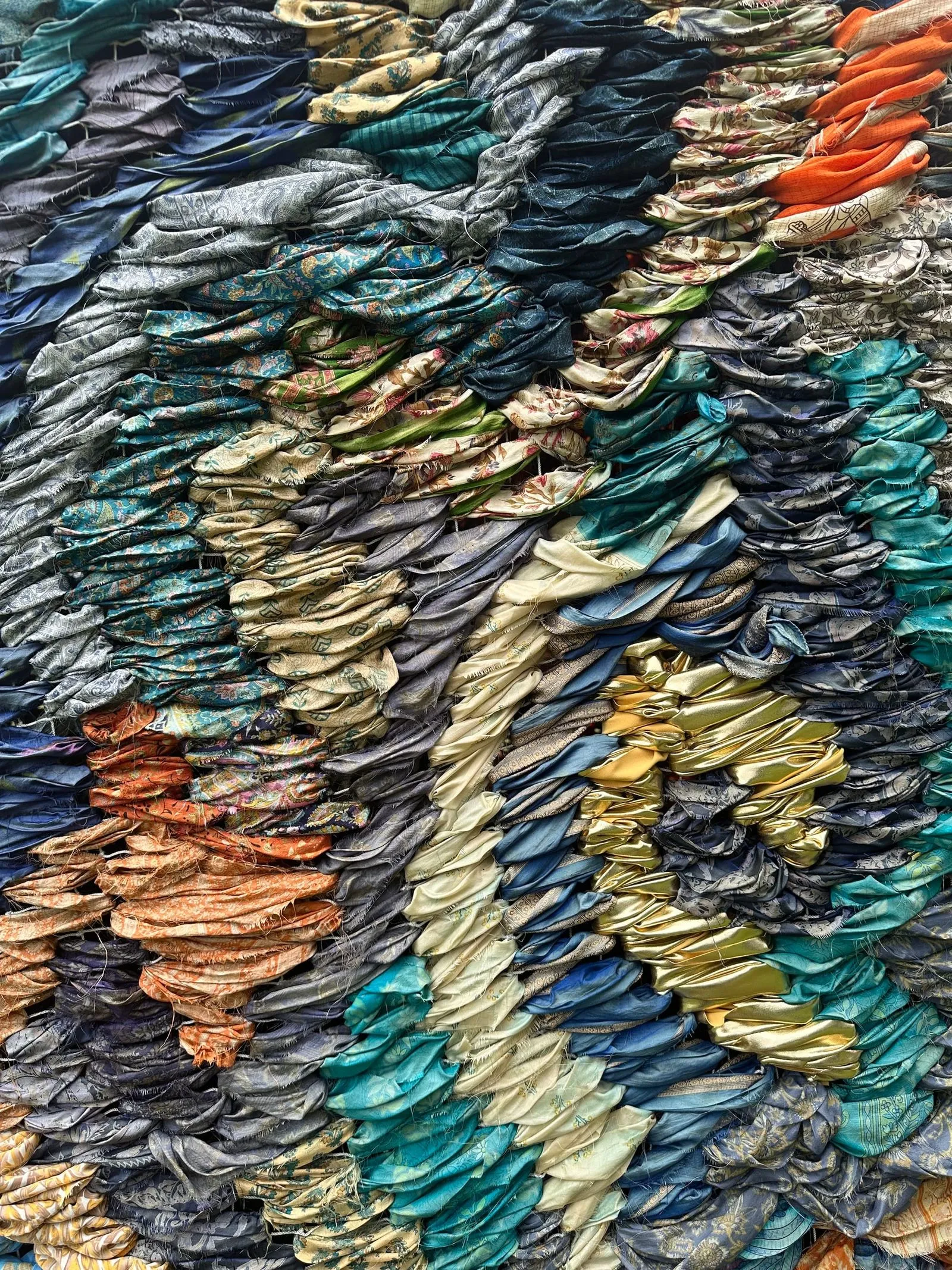
Countless individual saris were woven into metal armatures to create each sculpture.
What would you say are success factors that brought you to where you are today?
I have a wonderful family. My husband, mother and sisters have encouraged me for years. My father has come around to loving art. I couldn’t have accomplished anything without them. I have also worked with many wonderful (women) curators who have given me amazing opportunities like Lauren Haynes, Prof. Grace Aneiza Ali at NYU and Claire Tancons, who invited me to be in the Sharjah Biennial. I am also stubborn and never stopped fighting to be the artist I wanted to be.
Are monsters always negative or a bad thing?
I don’t think monsters are bad. I think they are these constructs that allow us to explore subjects that are unknown, unfamiliar, sometimes magical. I don’t see them necessarily as bad, but they can stand in for danger. To me, it’s always about the unknown.
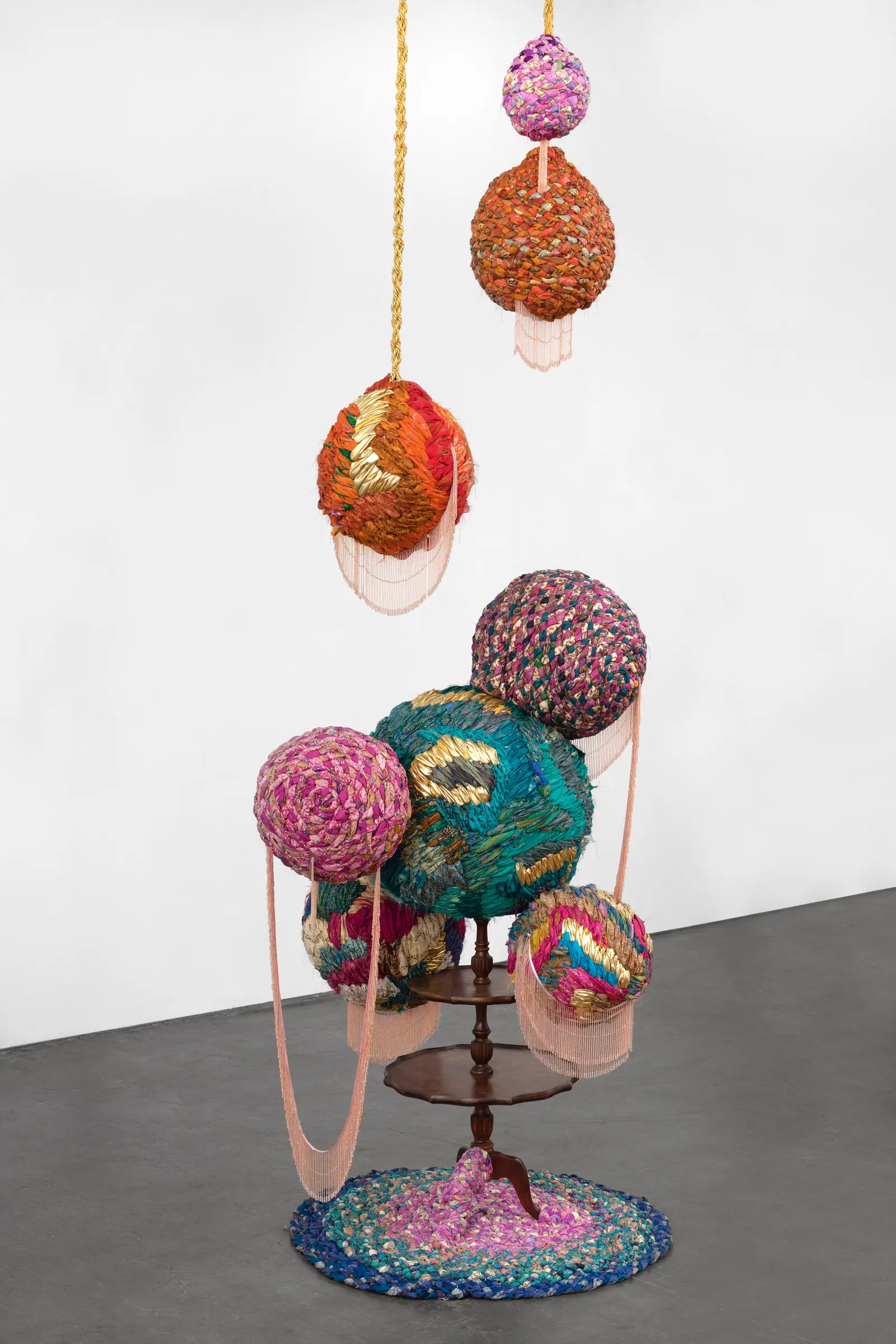
Suchitra Mattai
to touch the sky, 2024
Worn saris and vintage tables
110 x 43 x 41 in (279.4 x 109.2 x 104.1 cm)
JO: It literally looks like a waterfall. Can you tell me more about how that ties into the form, the shape of the way you assembled this?
SM: In my work, I often allude to a lot of myths, whether it’s related Hindu mythology or Greek mythology and folklore. I think that the Kaieteur Falls and Guyana are, in a way, a site of El Dorado.
Growing up, everybody would talk about them: “hh, if you go back to Guyana, you’ve got to go see the Kaieteur Falls!” It’s like Guyana’s claim to fame, other than a really terrible incident that happened cult wise a long time ago. It’s like a physical site, but one that’s ethereal as well and holds that sense of mythology. So I wanted to recreate it, thinking about my own past.
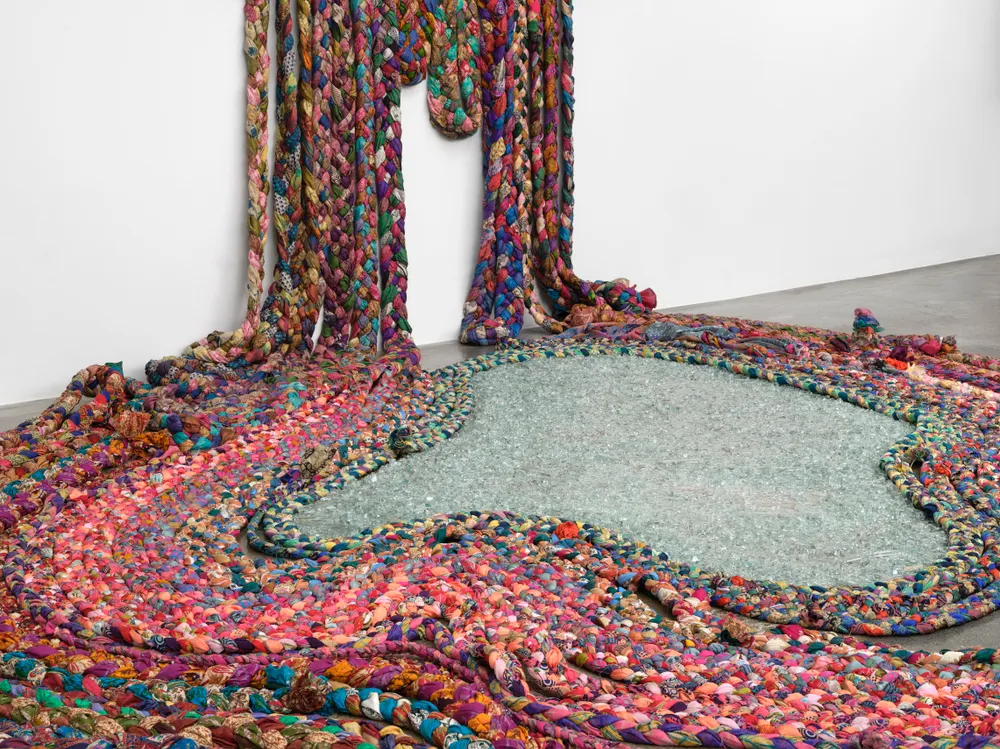
Suchitra Mattai (Indo-Caribbean, b. Guyana, 1973), The Fall, 2025, worn saris, broken glass from an attempted studio break-in, installation dimensions variable. Courtesy the artist and Roberts Projects, Los Angeles. Photo by Paul Salveson.
She borrows from great female masters, too: A towering resin sculpture by Louise Bourgeois, “Legs” (1986), stands sentinel in a gallery that includes several works by Mattai that feature paired figures.
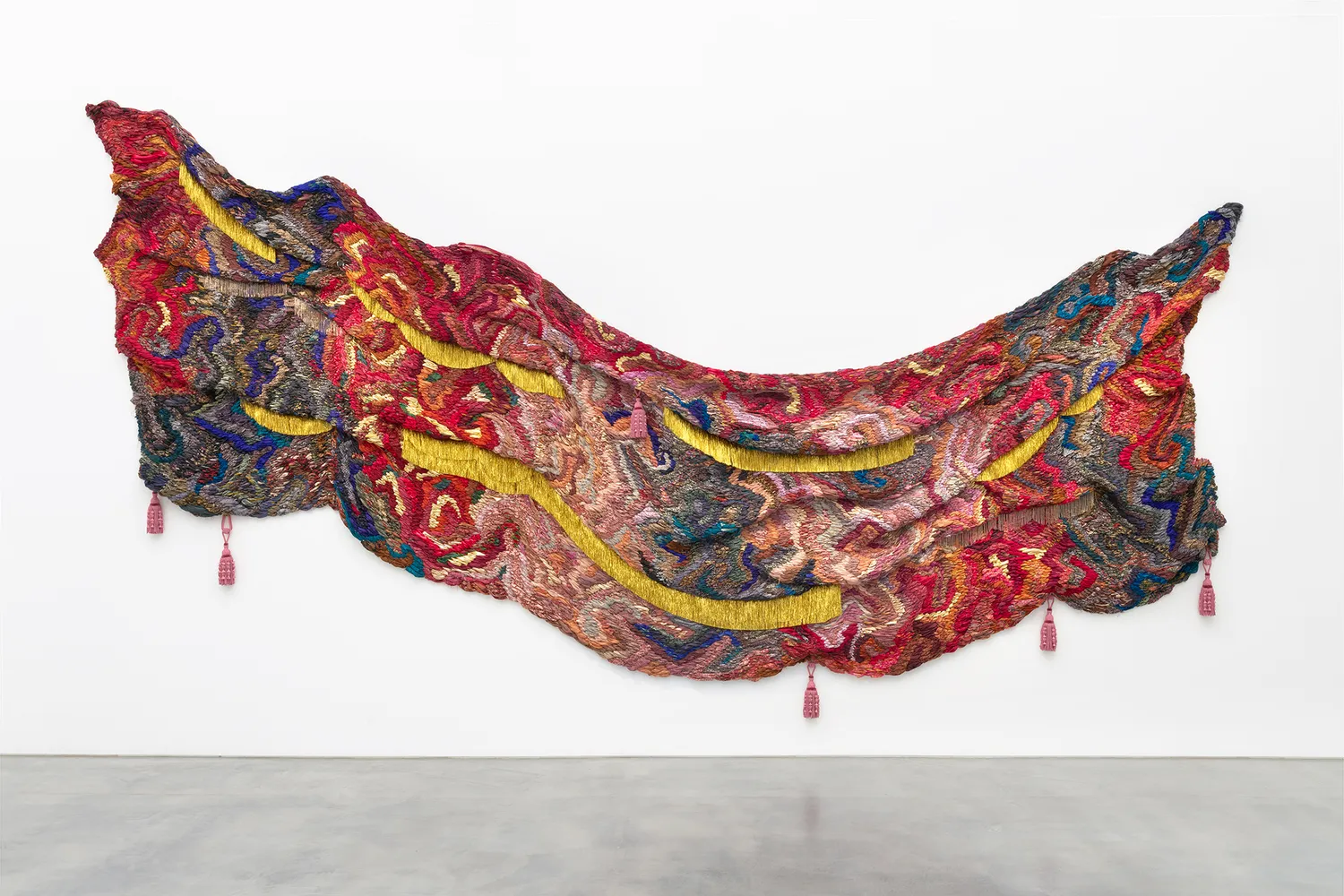
Suchitra Mattai
a cosmic awakening, 2023
Vintage saris, fabric, tinsel, beaded fringe and tassels
150 x 288 in (381 x 731.5 cm)
Kuch Hai Features
Profiles and interviews
- Suchitra Mattai's Woven Sculptures Give Voice to Women Around the World (W Magazine, Salomé Gómez-Upegui, September 25, 2024)
- New Mythologies: A Conversation with Suchitra Mattai (Sculpture | A publication of the International Sculpture Center, Jan Garden Castro, November 7, 2024)
- In conversation: Melissa Baksh interviews Suchitra Mattai (Journal of Indentureship and Its Legacies, Melissa Baksh, January 11, 2024)
- Suchitra Mattai Plants the Monument We Need (Hyperallergic, Lakshmi Rivera Amin, November 6, 2024)
- Suchitra Mattai and Sugar Bound (Guyana Modern, Patrick Bova, September 17, 2018)
- 10 Questions with Suchitra Mattai (LES ÎLES, August 31, 2020)
- Interview: Suchitra Mattai (Past Present Projects, Heather Moqtaderi, September 29, 2022)
- Suchitra Mattai on 'The Fall' (Whitehot Magazine, Jonathan Orozco, July 2025)
- The Vivid Thread of Memories by the Yard (The New York Times, December 27, 2024)
- 74: Navigating Nostalgia, History and Curiosity through textiles and paint with Suchitra Mattai (Artist/Mother Podcast, Kaylan Buteyn, October 19, 2020)
Watch
The Artists Roundtable: Suchitra Mattai (School of Visual Arts, December 3, 2024)
Artist Interview: Suchitra Mattai on "Bodies & Souls" (Tampa Museum of Art, March 29, 2025)
Unraveling Stories of the Past | Interview with Suchitra Mattai (Seattle Art Museum, May 21, 2025)
Artist Spotlight - A Studio Tour with Suchitra Mattai: Interviewed by Lauren Haynes (Crystal Bridges, November 18, 2020)